
Tech and AI Coaching Integration
By: Patrick Stephenson
Is AI your new golf coach?
For most of golf history, a lesson depended almost entirely on one thing: what the instructor could see.
A good coach could watch a player hit several shots, identify a movement pattern and prescribe a change. Video eventually gave instructors the ability to slow down a golf swing and compare positions. Launch monitors added precise measurements of what the club and ball were doing at impact.
Now artificial intelligence and three-dimensional motion tracking are changing golf instruction again.
The difference is not simply that coaches have access to more information. Technology is becoming capable of organizing and interpreting that information in ways that would have been nearly impossible for the average golfer even a decade ago.
Golfers have been drawing lines on two-dimensional swing videos for years, but traditional video has limitations. Camera angle changes how positions appear, and movements occurring toward or away from the camera can be difficult to evaluate accurately.
Modern motion-analysis technology is beginning to solve that problem.
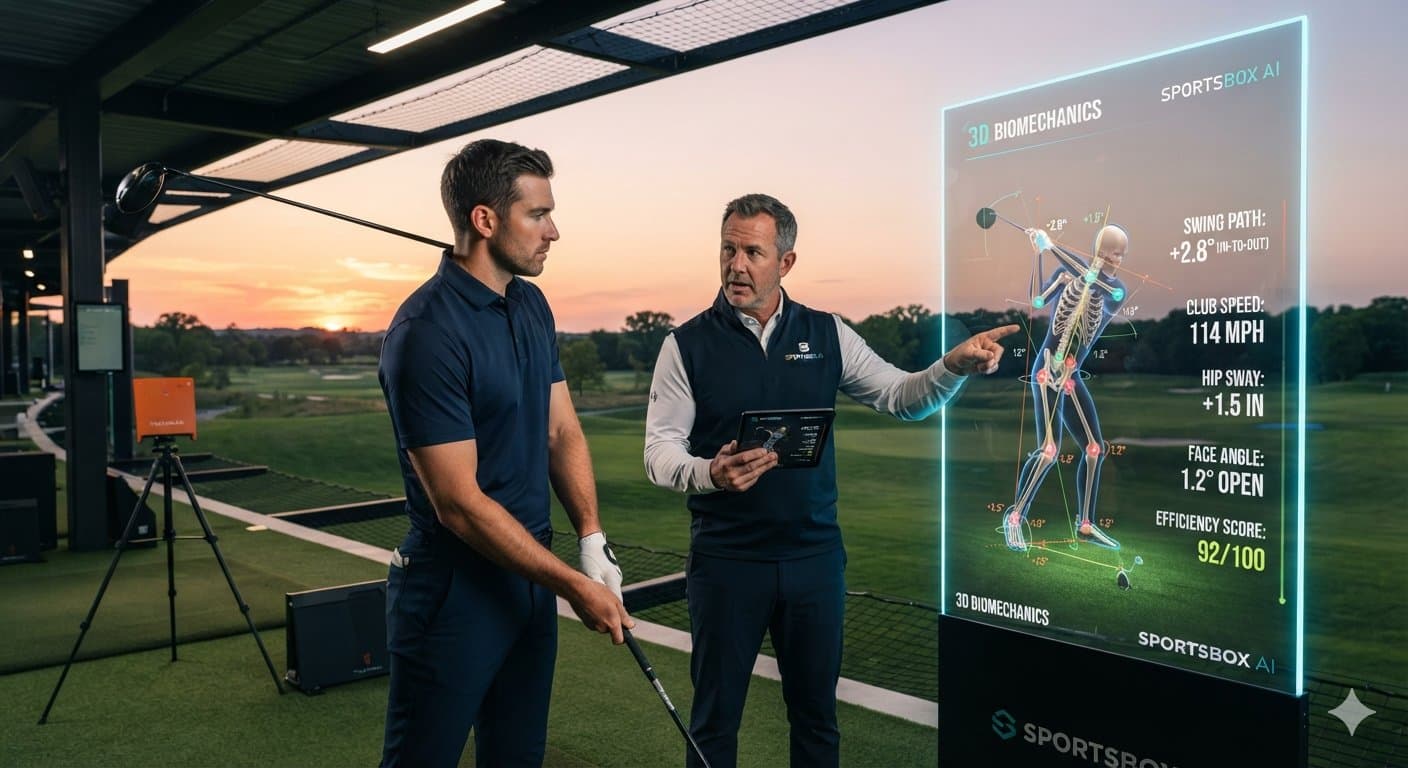
Systems such as Sportsbox AI can take ordinary smartphone video and create a three-dimensional representation of a golfer's movement. Instead of simply seeing that a golfer's hips moved during the swing, a coach can measure how much they moved and compare those measurements across different swings.
GOLFTEC's OptiMotion system takes a similar approach using dual cameras and sensorless motion capture, collecting thousands of data points involving movements of the hips, shoulders and other parts of the body.
TrackMan has also expanded beyond measuring only what happens to the club and ball. Its AI Motion Analysis technology can identify and display movements such as shoulder and hip positions, head movement and wrist path.
The result is a golf lesson that is becoming less dependent on guessing.
Turning More Data Into Better Answers
The challenge is that modern golf technology can quickly produce more information than a golfer knows what to do with.
A single launch-monitor shot may show club path, face angle, attack angle, dynamic loft, spin rate, launch angle, carry distance and numerous other measurements.
Add three-dimensional body movement, putting data and on-course statistics, and the average player can easily become overwhelmed.
That is where artificial intelligence may have its greatest impact.
The most useful role for AI in golf coaching may not be teaching someone how to swing. It may be identifying which pieces of information actually matter.
A golfer hitting a weak fade does not need to improve 15 different numbers. He needs to understand the few variables actually creating the shot and determine which one should be addressed first.
AI-powered systems can analyze patterns across multiple swings rather than forcing the player to sort through each measurement individually.
TrackMan's technology, for example, now includes tools intended to help golfers identify areas of their games that need attention. Its Upgame platform takes on-course shot data and organizes it into strokes-gained analysis, dispersion patterns and specific performance trends.
That begins to connect two areas of golf instruction that have historically been treated separately.
One side explains what a golfer is doing on the practice tee.
The other explains what is actually costing him shots on the course.
A player may believe his driving is holding him back only to discover that approach shots from 100 to 150 yards are responsible for most of the gap between his current handicap and the level he wants to reach. Another golfer may spend hours rebuilding his swing when his ball-striking statistics are already good enough and his biggest weakness is putting.
Better technology makes those distinctions easier to identify.
The smartphone may ultimately become one of the most important pieces of golf training equipment because it makes much of this analysis available without requiring a laboratory full of sensors.
A golfer can record a swing, receive 3D motion information and send the video to an instructor located hundreds of miles away. Competitive players can send tournament swings to their coaches instead of waiting weeks for the next in-person session.
The relationship between the coach and player becomes more continuous.
Instead of returning to the next lesson and saying, "I think I have been doing it correctly," a golfer can potentially provide measurable evidence of whether the change is actually happening.
That has the potential to make practice far more efficient.
Golf is filled with misleading feels. A player may believe he made a dramatic swing change when video shows almost no difference. Another may exaggerate a movement only to discover that the actual change was a few degrees.
Technology provides immediate feedback and allows both the golfer and instructor to track progress over time instead of relying primarily on memory.
Why the Golf Coach Still Matters
The obvious conclusion is that artificial intelligence will eventually replace golf instructors.
That is probably too simplistic.
Technology is becoming extremely good at measurement.
Coaching still requires interpretation.
Two golfers can produce the same swing characteristic for completely different reasons. One player may have a physical limitation. Another may have an equipment problem. A third may simply misunderstand what he is trying to accomplish.
Knowing that someone's pelvis moved four inches does not automatically explain why it moved or whether changing it will actually make him a better golfer.
A skilled instructor also understands the person standing in front of him.
Some players respond well to technical explanations and detailed numbers. Others become considerably worse when they begin consciously controlling individual body parts.
One golfer may need to see the data. Another may need a drill. A third may simply need to hear, "Hit the ball over there."
The best coaches understand when information helps and when it becomes a distraction.
That may become even more important as golfers gain access to increasingly sophisticated technology.
More data also creates the temptation to chase perfect numbers.
Golfers already compare their positions with professional players. Three-dimensional motion capture makes those comparisons easier and more precise than ever.
That does not mean every golfer should move the same way.
Professional golfers themselves have dramatically different swings. Body type, mobility, strength, speed and playing style all influence how someone moves.
A measurement should therefore be treated as information rather than a universal target.
The question is not whether a golfer's swing perfectly matches a model.
The question is whether a particular movement is contributing to the ball-flight or performance problem that player is trying to solve.
That distinction will determine whether artificial intelligence becomes one of golf instruction's most valuable tools or simply another source of swing information for golfers to obsess over.
The most likely future is not entirely human coaching or entirely digital instruction.
It is a combination of both.
Launch monitors can explain what happened to the club and ball. Motion-analysis technology can show how the golfer moved. On-course tracking can identify where shots are actually being lost. Artificial intelligence can organize those measurements and recognize patterns.
The instructor can then decide what the player should actually do about them.
That final step remains the most important.
Golfers do not need more numbers.
They need better answers.
Artificial intelligence may become extremely good at finding the relevant information. The best instructors will be the ones who can take that information and turn it into a simple change a golfer understands, practices and eventually trusts on the golf course.
The technology behind golf instruction is becoming more complicated.
Its greatest value may be making improvement feel simpler.