
Is Golf Headed Toward a Pro vs Amateur Equipment Split
By: Patrick Stephenson
Golf has spent years debating whether the professionals should be playing the same equipment as everyone else.
That debate is no longer hypothetical.
In September, the USGA and R&A asked equipment manufacturers to provide feedback on three potential Model Local Rules designed to limit distance at the elite level. The proposals could affect the golf ball, driver face and maximum club length used in certain professional and elite competitions as early as 2028.
For the average golfer, however, nothing in his golf bag would suddenly become illegal.
Instead of reducing distance for everyone, golf's governing bodies are again considering a system in which elite players compete under tighter equipment restrictions while recreational golfers continue using the drivers, golf balls and other equipment currently available at retail.
Call it bifurcation, a professional equipment rule or simply another Model Local Rule.
Whatever term golf chooses, the game may finally be moving toward an uncomfortable reality:
Scottie Scheffler may not need to play exactly the same equipment as the 15-handicapper at the local municipal course.
What the USGA and R&A Are Actually Proposing
There are three equipment changes currently under consideration, and two of them sound considerably more complicated than they actually are.
The first involves the golf ball.
The USGA and R&A do not determine whether a golf ball conforms by handing it to a professional golfer and seeing how far he hits it. Balls are tested under controlled launch conditions designed to remove the player from the equation.
Under the current Overall Distance Standard test, a ball is launched under standardized conditions using a robot that include a 120-mph clubhead speed, a 10-degree launch angle and approximately 2,520 rpm of spin. The governing bodies then measure its overall distance, which includes both carry and roll.
The official limit is 317 yards, but the testing process currently includes a three-yard tolerance. That means a ball can test as long as 320 yards and still be considered conforming.
The proposed Model Local Rule for elite competition would essentially eliminate that extra room. A golf ball used in an event adopting the rule would need to test at 317 yards or less.
Three yards does not sound significant.
For a recreational player, it probably isn't.
At the highest levels of golf, however, these rules are being discussed precisely because the game is increasingly played on small margins. A few yards can determine whether a player carries the final bunker in a fairway or has to play short of it. It can determine whether a corner of a dogleg is available or whether the player is forced to shape a tee shot through the intended portion of the hole. And for players with more than 120 mph of club speed, it can mean more than 3 yards.
The second proposal deals with the spring-like effect of a driver face.
This is measured through something called Characteristic Time, or CT. The easiest way to understand CT is to think about how much the face acts like a trampoline when the golf ball hits it.
To test it, the governing bodies use a small pendulum with a metal weight on the end and strike the clubface. The equipment measures how long the pendulum remains in contact with the face.
A more flexible face gives slightly during the collision and keeps the pendulum in contact with it for a fraction longer. A stiffer face produces a shorter contact time.
That time is measured in microseconds.
The current CT target is 239 microseconds, but there is an 18-microsecond testing tolerance. A driver can therefore measure as high as 257 microseconds and still fall within the current limit.
The proposed elite Model Local Rule would remove that buffer and establish 239 microseconds as the maximum measurement for a driver being used in competition.
It is important not to exaggerate what that means. A driver measuring 257 is not suddenly launching the ball 15 yards farther than one measuring 239. The existing tolerance is largely there because of the realities of testing and manufacturing.
Still, the proposal would create a tighter standard for the drivers used at the highest level and reduce the opportunity for players and manufacturers to operate near the current outer limit.
The third proposal involves club length.
Golf already has an optional Model Local Rule limiting every club other than the putter to 46 inches. The PGA Tour and many elite competitions use that rule.
Now the USGA and R&A are considering lowering that limit again, although they have not yet specified exactly how short it would become.
The potential advantage of a longer driver is relatively straightforward. A longer shaft creates a larger swing arc and can allow a player to generate additional clubhead speed. More speed creates the potential for more ball speed and more distance.
There is a tradeoff. Longer drivers can be more difficult to control and make center contact harder to achieve, which is one reason most Tour professionals already play drivers well below the 46-inch maximum.
But elite golf is often decided at the margins. If an extremely skilled player can handle the additional length and gain a few miles per hour without losing control, there is a potential advantage. A shorter maximum would limit that avenue for future distance gains.
Manufacturers have until October 21, 2026, to provide feedback. If the governing bodies move forward, the rules could potentially become available in January 2028, which would be a relatively quick turnaround by golf equipment-rule standards.
The important part for recreational golfers is what these proposals would not do.
Your current driver would not suddenly become nonconforming. The golf balls already sitting in your golf bag would not become illegal. Equipment companies could continue producing and selling products under the broader Equipment Rules.
These would be optional Model Local Rules adopted by competitions that choose to use them.
That also means calling this simply a "professional versus amateur" rule is not completely accurate.
The distinction would be based on the competition, not whether someone receives a paycheck.
An amateur who qualifies for a PGA Tour event using the Model Local Rules would need compliant equipment. An elite amateur championship such as the U.S. Amateur could potentially choose to adopt similar restrictions. Meanwhile, the recreational golfer playing Saturday morning at his local club could continue using the equipment he already owns.
The real split would be between elite competition and the rest of golf.
Why Golf Keeps Coming Back to Bifurcation
The interesting part of this proposal is that golf has already been here.
In 2023, the USGA and R&A originally proposed a Model Local Rule that would have introduced a reduced-distance golf ball specifically for elite competitions.
The reaction was immediate.
Equipment manufacturers objected. Professional golfers questioned why the sport needed two golf balls. Critics argued that one of golf's unique characteristics is that recreational players can walk into a golf shop and buy essentially the same equipment used by the best players in the world.
The governing bodies eventually abandoned that approach.
Instead, they announced an across-the-game change to the Overall Distance Standard. The revised testing procedure was originally scheduled to affect elite competition beginning in 2028 before applying to everyone in 2030.
That meant the average golfer would eventually experience the rollback too.
By 2026, however, the conversation changed again.
The USGA, R&A, PGA Tour and DP World Tour released a joint statement in June acknowledging that distance was continuing to increase at the elite level while the tours had concerns about whether the planned golf-ball testing change would produce the desired result.
There was also increased interest in finding a solution that would minimize disruption to the recreational golf market.
The governing bodies delayed any change to the Overall Distance Standard until at least January 2030 while reopening the discussion around elite-specific alternatives.
Three months later, the latest Model Local Rule options arrived.
Golf has essentially circled back to bifurcation.
There is a good argument that this is where the conversation should have remained from the beginning because the distance problem looks completely different depending on who is holding the driver.
Clubhead speed matters enormously.
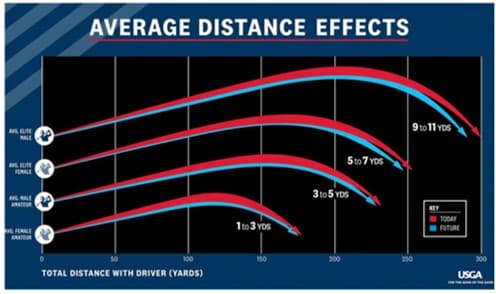
A small equipment change that produces only a modest percentage difference becomes more noticeable when applied to someone swinging 120 or 125 mph than someone swinging 90.
There is also the way those yards interact with a golf course.
For a Tour player or elite amateur, an additional five to 10 yards of carry can be the difference between flying a cross bunker and having to fit a drive into the narrow section of fairway short of it.
That changes the hole.
A small reduction in carry can therefore have a much larger effect on strategy than the raw yardage number suggests.
The best golf-course architecture forces decisions.
A bunker at 295 yards matters if the player has to decide whether to challenge it. It stops mattering when most of the field can comfortably fly the ball over it.
A dogleg matters when the golfer must work the ball around the corner. It changes when players can simply launch driver over the trees.
PGA Tour players now routinely carry the ball distances that would have seemed extraordinary a generation ago, and the longest players can average well beyond 320 yards off the tee.
Golf courses have responded by moving tees farther back, adding length and redesigning hazards.
That works until there is nowhere left to go.
For some of America's great landlocked golf courses, there simply is not enough property available to keep stretching the scorecard. Roads, homes, property lines and existing architecture limit how far tees can be moved back.
At some point, adding distance also begins changing the golf course that made the venue worth using in the first place.
That is why five yards can matter considerably more than it sounds.
Now compare that problem with the average recreational golfer.
Most amateurs are not overpowering golf courses.
They are trying to reach greens in regulation and keep their ball in play.
A Tour player losing enough distance to turn a driver-wedge par 4 back into a driver-7-iron hole could meaningfully restore part of the intended challenge.
Taking several yards from a player who carries driver 215 does not accomplish the same thing. It may simply leave him hitting a longer club into an already difficult green.
The two golfers are playing the same sport, but they are not creating the same equipment problem.
That is the strongest argument for separate elite standards.
Would Two Equipment Standards Actually Be Bad for Golf?
For years, equipment companies have marketed golf clubs and balls around a powerful idea:
You can play what the professionals play.
A TaylorMade, Titleist, Callaway, Ping or Cobra driver sitting in a retail golf shop is built under the same basic Equipment Rules governing the clubs used on Tour.
There are differences in shafts, fitting, prototypes and Tour-only specifications, but the fundamental performance limits are the same.
Elite-specific rules could create a more meaningful separation.
Manufacturers could eventually build driver heads specifically designed to satisfy the tighter CT requirement. Tour golf balls could be selected or designed to fit within the 317-yard elite standard. Driver builds might change if the maximum length is lowered.
That sounds disruptive, but for recreational golfers it may actually be the better outcome.
A golfer swinging driver at 90 mph does not have the same equipment needs as someone swinging 125.
The average golfer benefits from ball speed, forgiveness, launch and equipment that helps imperfect contact travel farther.
There is little reason to intentionally make that golfer's game harder because the best players in the world have become extraordinarily efficient at producing speed.
A true elite Model Local Rule would allow equipment manufacturers to keep designing consumer products around helping ordinary golfers play better while addressing the distance issue where it actually exists.
It could even create a strange reversal in the way golfers think about "Tour equipment."
For decades, golfers have loved carrying Tour-inspired gear in their golf bags.
Under an elite equipment rule, the driver being used on the PGA Tour could theoretically be more restricted than the driver sitting on the rack at your local golf store.
The professional would be the golfer using restricted technology.
The amateur would not.
There is also a legitimate question about how much demand there would be for elite-spec equipment among recreational players.
Most golfers have little reason to purchase a golf ball specifically because it travels shorter or a driver intentionally built below the performance limit available to them.
For perhaps the first time, "Tour issue" could describe equipment that provides less of a benefit to the average golfer.
The strongest argument against bifurcation has always been tradition.
Golf allows recreational players to walk onto many of the same courses, follow the same Rules and use equipment governed by the same standards as the best players in the world.
That connection is meaningful.
It is also already imperfect.
The average golfer is not playing a U.S. Open setup. He is not hitting from 7,600-yard tees. The rough at his local club is not maintained to major-championship standards. Professional events already adopt Model Local Rules that weekend golfers never think about.
Most recreational rounds do not even follow every Rule of Golf perfectly. Players take gimmies, move balls off roots, replay the occasional breakfast ball and pick up after reaching their maximum for the hole.
Golf already adjusts itself to the level at which it is being played. Equipment may simply become another part of that equation.
The key is keeping the separation simple.
Golf does not need one golf ball for scratch players, another for 10-handicappers and a third for beginners. It does not need golfers standing on the first tee of a club championship wondering whether the driver in their golf bag is legal.
A clearly defined elite Model Local Rule is different.
Professional tours and designated elite championships could adopt specific equipment restrictions.
Everyone else continues playing under the normal Equipment Rules.
That still protects something important about recreational golf:
Distance is fun.
Watching a drive carry farther than expected is fun. Reaching a par 5 in two for the first time is fun. Finding a new driver that adds eight yards to your golf bag is fun.
Golf should be careful about taking those experiences away from millions of ordinary players in an effort to solve a professional problem that exists on razor-thin margins.
At the same time, elite golf should remain a test of more than speed.
The best golf courses create decisions. They reward positioning, trajectory control and the ability to use different clubs throughout the bag.
If five yards determines whether a bunker is relevant, then five yards can matter.
If equipment advancement eventually allows elite players to bypass too much of the strategy built into great golf courses, reasonable restrictions can make championship golf more interesting without making recreational golf more difficult.
The latest USGA and R&A proposal is not final. The manufacturer-comment period remains open, the proposed maximum club length has not been established and the governing bodies could change direction again before 2028.
Golf has done that before.
But the philosophy behind this proposal may matter more than whether the eventual number is 317 yards, 239 microseconds or a particular driver length.
After years of trying to create one equipment solution for two completely different versions of the game, golf appears increasingly willing to acknowledge that the solution for Rory McIlroy does not have to be the solution for the golfer trying to break 90.
They are playing the same game.
At the extremes, they are facing very different problems.
The professional may eventually have a slightly different driver and golf ball in his bag.
The rest of us can keep ours.
That may be less radical than asking both groups to solve a problem only one of them created.